

Key Takeaways
- Rate cuts are not imminent. As of September 11, 2026, the Federal Reserve holds its benchmark rate at 3.50–3.75%, and futures markets were pricing a rate increase as more likely than a cut ahead of the September 15–16 meeting.
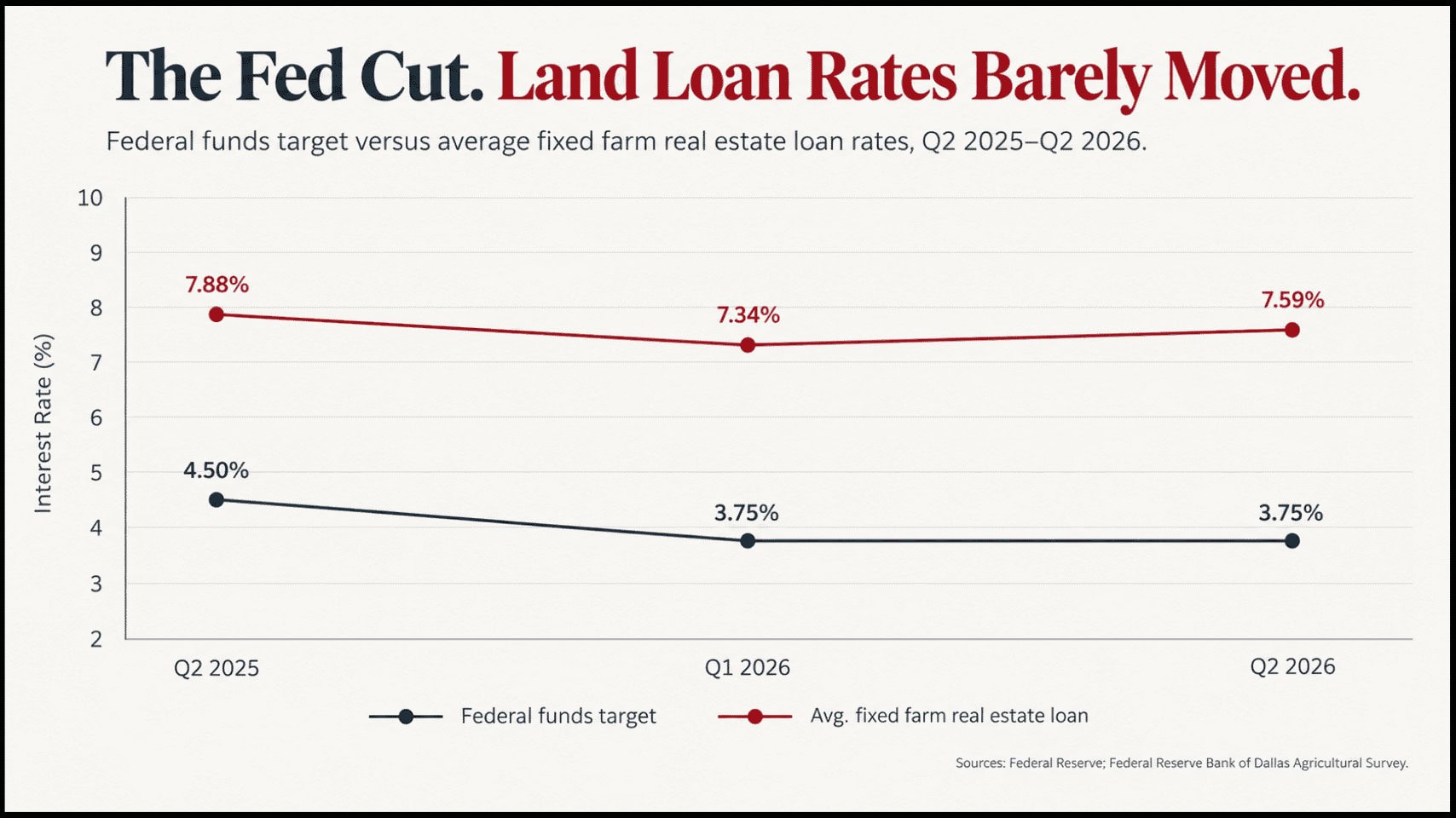
- Fed cuts do not automatically lower land loan rates. The Fed cut 1.75 percentage points between September 2024 and December 2025, yet the average fixed farm real estate loan rate in the Dallas Fed district was still 7.59% in Q2 2026, down only from 7.88% a year earlier.
- Rates move land sales volume first and prices second. Texas rural land sales volume fell three straight years after the 2022 rate hikes began, while the statewide median price per acre kept rising.
- Texas land prices are holding near record levels. The Texas Real Estate Research Center reports a Q2 2026 statewide median of $5,218 per acre, up 3.27% year over year, with Austin–Waco–Hill Country at a record $8,040 per acre.
- Lower rates would bring financed buyers back into the market. On a $1.5 million land purchase, a drop from 7.59% to 6.50% cuts the loan payment by about $737 a month, or lets the same payment carry roughly 9% more debt.
Will interest rates go down in 2026?
As of September 11, 2026, a rate cut this year looks unlikely. The Federal Reserve is debating whether to raise rates, not lower them, because an energy-driven jump in inflation has pushed the 10-year Treasury yield to its highest level since 2023.
The Fed’s target range for the federal funds rate stands at 3.50–3.75%, where it has been since December 2025. At the July 28–29 meeting, the Federal Open Market Committee held rates steady on a 9–3 vote, and all three dissenters wanted a quarter-point increase. In late August, Fed Chair Kevin Warsh said at the Jackson Hole symposium that underlying inflation trends had not meaningfully improved. Heading into the September 15–16 meeting, CME FedWatch pricing showed better-than-even odds of a rate hike.
The August Consumer Price Index, released September 11, explains the pressure. Headline inflation ran 3.4% over the prior 12 months, and the energy index rose 16.3% as crude oil traded above $100 a barrel. Core inflation, which excludes food and energy, rose just 2.4% year over year, down from 2.5% in July.
That gap is the most realistic path to lower rates. If energy prices ease and core inflation stays near the Fed’s 2% goal, the argument for hiking weakens, and cuts become possible in 2027. Until then, Texas land buyers and sellers should plan around current borrowing costs rather than a rate cut that may not come soon.
Why a Fed rate cut does not automatically lower your land loan rate
The Federal Reserve sets an overnight lending rate, while most long-term land and ranch loans are priced off longer-term Treasury yields. When inflation expectations stay high, long-term rates can hold steady or even rise after the Fed cuts.
The last cutting cycle shows how this works. The Fed lowered its benchmark rate by a combined 1.75 percentage points between September 2024 and December 2025, including 0.75 points in the second half of 2025. Across that stretch, the Federal Reserve Bank of Dallas reported that the average fixed rate on farm real estate loans across its district moved from 7.88% in Q2 2025 to 7.34% in Q1 2026, then rose back to 7.59% in Q2 2026. The 30-year fixed mortgage averaged 6.76% in the week ending September 10, 2026, according to Freddie Mac, up from 6.35% a year earlier.
Different loans react to Fed moves in different ways:
- Variable-rate, construction and development loans are usually tied to prime or SOFR, which follow the federal funds rate closely. Developers and land bankers feel Fed cuts first.
- Long-term fixed land loans from Farm Credit associations, community banks and life insurance lenders follow the 10-year Treasury and lender funding costs. These fall only when the bond market expects inflation to stay contained.
- Seller-financed notes are negotiated one deal at a time. They often price below bank rates when a seller wants a wider pool of buyers or wants to spread capital gains over several years.
Farm Credit patronage programs, which return part of a borrower’s interest each year, can bring the effective cost of a land loan below the note rate. Buyers comparing lenders should ask for the association’s recent patronage history along with the quoted rate.
How do interest rates affect Texas land prices?
Interest rates affect Texas land sales volume more than land prices. When rates rise, fewer tracts trade, but sellers under no pressure to sell usually hold their prices instead of cutting them. When rates fall, the number of sales usually recovers before prices move.
Research from the Texas Real Estate Research Center (TRERC) at Texas A&M identifies three primary drivers of Texas rural land prices and sales activity: the federal funds rate, Texas personal income and oil prices. Rates are one lever, and they work together with how much Texans earn and how the energy economy is performing.
The 2022–2025 cycle shows the pattern. After the Fed began raising rates in 2022, statewide rural land sales volume declined for three consecutive years from its 2021 peak. Prices did not follow volume down. TRERC’s Q4 2025 report shows a statewide median of $5,214 per acre, up 6.56% for the year, with five-year compound annual growth of 10.73%. Sales volume recovered 8.16% in 2025 but was still 29.37% below 2019 levels, and total acres sold were 33.86% below 2019.
TRERC describes the current market as a standoff. Many sellers are anchored to peak 2022–23 valuations, and buyers remain cautious after five years of steep appreciation and elevated borrowing costs. Q2 2026 data shows the result: statewide sales rose 4.34% to 3,753 transactions, while total acres sold fell 12.57% and total dollar volume fell 9.72%. Buyers are still active, but they are buying smaller tracts at defensible prices.
What a lower rate means on a $1.5 million Texas land purchase
|
Fixed rate |
Monthly payment | Annual payment | Total interest (20 yrs) | Loan the same $9,125/mo payment supports |
|---|---|---|---|---|
| 7.59% (Q2 2026 Dallas Fed avg.) | $9,125 | $109,499 | $1,064,984 | $1,125,000 |
| 7.00% | $8,722 | $104,665 | $968,307 | $1,176,957 |
| 6.50% | $8,388 | $100,652 | $888,047 | $1,223,882 |
| 6.00% | $8,060 | $96,718 | $809,364 | $1,273,665 |
| 5.50% | $7,739 | $92,865 | $732,296 | $1,326,516 |
Example: 100 acres at $15,000 per acre, 25% down, $1,125,000 financed on a 20-year fully amortizing fixed-rate loan. Illustrative only; actual terms vary by lender, borrower and property. Calculations by Andrus Land Group.
What would lower rates mean for different types of Texas land?
Lower rates would help Houston-corridor transitional land and financed homesite buyers the most. Recreational ranch buyers, who more often pay cash or use equity, would feel less of an effect. Production agriculture depends more on commodity prices than on rates.
- Transitional and development land in the Houston growth corridor. Tracts along the I-10 and US-290 corridors through Waller, Austin and western Fort Bend counties are the most rate-sensitive segment in Southeast Texas. Builder and developer demand runs on short-term financing tied directly to the federal funds rate, so a Fed cut quickly improves project math on this kind of land.
- Homesite and small-acreage tracts. Buyers of 10- to 100-acre tracts are the most likely to finance, so their buying power moves with loan rates. The Austin–Waco–Hill Country region set a record Q2 2026 median of $8,040 per acre, up 8.63%, on 1,062 sales, driven by demand for recreational and homesite property.
- Gulf Coast–Brazos Bottom land. This region’s Q2 2026 median of $11,369 per acre (up 3.05%) remains near record levels, but total acres sold fell 6.35%. Returning financed buyers would mostly raise transaction counts here, since values are already high.
- Recreational and legacy ranches. Larger turnkey ranches trade more on wealth, equity markets and lifestyle demand than on mortgage rates. Lower rates help at the margin, but scarcity of quality ranches near Houston matters more to value.
- Production cropland and grazing land. Dallas Fed survey respondents report tight farm margins from low commodity prices and high input costs, even as cattle prices remain historically strong. Texas dryland cropland values still rose 7.7% and ranchland 3.6% year over year in Q2 2026, supported by competition from non-agricultural buyers.
Three rate scenarios for the Texas land market in 2026–2027
How the Texas land market moves over the next 12 to 18 months depends less on whether rates fall than on why they fall.
- Higher for longer (the case markets are pricing today). The Fed holds or raises rates through late 2026 to contain energy-driven inflation. Sales volume stays thin, cash and 1031 exchange buyers dominate, and properties priced to current comparable sales still close. Sellers holding out for 2022–23 pricing sit longer on the market.
- Gradual easing in 2027. Energy prices come down, core inflation holds near 2%, and the Fed begins cutting. Long-term land loan rates fall slowly, financed buyers return, and sales volume recovers first. In areas with little supply, such as turnkey ranches and well-located Houston-corridor acreage, prices firm once buyers start competing again.
- Recession-driven cuts. The Fed cuts quickly because the economy weakens. Borrowing gets cheaper, but falling income and oil prices, the other two drivers in TRERC’s model, offset much of the benefit. In this scenario lower rates do not mean higher land prices, and patient buyers with capital gain leverage.
Should you buy Texas land now or wait for lower rates?
Waiting for lower rates means giving up a negotiating advantage buyers have now in exchange for a rate cut that may or may not arrive. Once rates fall, financed buyers come back and competition for the best tracts increases.
Today’s market gives qualified buyers more leverage than they have had in several years. Sellers who are not anchored to peak pricing are negotiating, and TRERC data points to fewer acres trading at prices that have leveled off. A buyer who purchases now at a defensible price may be able to refinance if long-term rates fall, but should confirm the prepayment terms before closing. A buyer who waits for cheaper money will likely be competing with many other buyers who waited for the same thing.
For financed buyers, the practical steps are to get pre-qualified with an agricultural lender, compare fixed and variable structures, and ask sellers directly about owner financing. Our buyer representation starts with the current Texas land listings and the comparable sales behind each asking price.
What should Texas landowners do if they plan to sell?
Landowners should price to today’s buyer, not to the 2022–23 peak or to hopes of a future rate cut. Well-prepared tracts priced in line with recent comparable sales are closing now, while overpriced tracts are the ones sitting on the market longest.
- Price to recent sales, not to rate forecasts. A rate cut widens the pool of buyers but does not make an overpriced tract sell.
- Consider seller financing. Offering terms can bring in financed buyers who have been priced out of bank loans, and an installment sale may help spread capital gains over time. Review structure and tax treatment with your CPA and attorney.
- Prepare the property now. A current survey, floodplain mapping, documented access, water sources, mineral status and ag or wildlife valuation history shorten the time from contract to closing.
- Time the listing against inventory, not headlines. Local supply of comparable tracts has a bigger effect on price than a quarter-point Fed decision.
A pricing analysis for your property compares your tract with recent Andrus Land Group sales and active competition in your county.
The Opportunity
Texas land has held its value through the fastest rate-hiking cycle in four decades. TRERC’s statewide median has leveled off nearly 50% above where it stood five years ago, Hill Country values set a new record, and Gulf Coast land remains near its peak. What slowed was the number of transactions, as financed buyers stepped back and sellers held firm.
That combination is unlikely to last. When long-term rates eventually ease, the financed buyers who have been waiting will return to a market with less inventory near Houston than they left, and the quality ranches, homesites and transitional tracts will trade first. Buyers who secure the right tract now at a defensible price, and sellers who price to today’s buyer instead of a past peak, will be in the best position when that happens. Follow the Texas Land Report for quarterly updates, or Contact Andrus Land Group to discuss a specific property.
Frequently Asked Questions
Will interest rates go down in 2026?
A rate cut in 2026 looks unlikely as of September 11, 2026. The Federal Reserve holds the federal funds rate at 3.50–3.75%, and futures markets were pricing a higher chance of a rate increase than a cut ahead of the September 15–16 meeting because energy prices had pushed headline inflation to 3.4%. Core inflation of 2.4% leaves room for cuts in 2027 if energy prices ease.
Does a Fed rate cut lower land loan rates in Texas?
Not directly. Variable-rate and construction loans tied to prime or SOFR fall soon after a Fed cut, but long-term fixed land loans follow the 10-year Treasury. Despite 1.75 percentage points of Fed cuts from September 2024 to December 2025, the Dallas Fed’s average fixed farm real estate loan rate was still 7.59% in Q2 2026, down from 7.88% a year earlier.
What are current land loan rates in Texas?
The Federal Reserve Bank of Dallas reported an average fixed farm real estate loan rate of 7.59% and an average variable rate of 7.43% across its district in Q2 2026. Actual rates depend on the lender, down payment, loan term, borrower credit and property type, and Farm Credit patronage can lower the effective cost.
How do interest rates affect Texas land prices?
Interest rates affect Texas land sales volume more than prices. After the Fed raised rates in 2022, Texas rural land sales volume fell three straight years, while the statewide median price per acre kept rising to $5,214 by the end of 2025, according to the Texas Real Estate Research Center.
Will lower interest rates make Texas land prices go up?
Lower rates would most likely raise the number of sales first, then firm prices in areas with little supply, such as Houston-corridor acreage and turnkey ranches. If rates fall because of a recession, weaker income and oil prices could offset the benefit of cheaper financing.
Should I buy land in Texas now or wait for rates to drop?
Buyers in 2026 have more negotiating leverage than they have had in several years because sales volume is down and sellers who price realistically are negotiating. Buying now at a defensible price and refinancing later, where the loan terms allow it, often puts a buyer in a better position than competing with returning financed buyers after rates fall.
What is the average price per acre of land in Texas in 2026?
The Texas Real Estate Research Center reported a statewide median rural land price of $5,218 per acre in Q2 2026, up 3.27% year over year. Regional medians were $11,369 per acre in the Gulf Coast–Brazos Bottom region and a record $8,040 per acre in the Austin–Waco–Hill Country region.
About the author: Chad Andrus, ALC, is the founder of Andrus Land Group and a two-time REALTORS® Land Institute Texas Land Broker of the Year (2023, 2024), with more than $130 million in land sales across 30,000+ acres. He specializes in farms, ranches, recreational property and transitional land in the Houston growth corridor and Central Texas.
Sources
- Federal Reserve, FOMC Statement, July 29, 2026
- Federal Reserve, Minutes of the FOMC, July 28–29, 2026
- U.S. Bureau of Labor Statistics, Consumer Price Index, August 2026
- Freddie Mac, Primary Mortgage Market Survey, September 10, 2026
- Federal Reserve Bank of Dallas, Agricultural Survey, Second Quarter 2026
- Federal Reserve Bank of Dallas, Agricultural Survey, Second Quarter 2025
- Texas Real Estate Research Center, Texas Rural Land Markets, Q2 2026
- Texas Real Estate Research Center, Texas Rural Land Markets, Q4 2025
- Texas Real Estate Research Center, Dynamics of Texas’ Rural Land Market
- Marketplace, Will the Fed Raise Rates at the September FOMC Meeting?, August 31, 2026
